
 Listen to article
The silent revolution
The automotive revolution is already happening — quietly, continuously and invisibly. It isn’t arriving in showrooms; it’s compiling in servers, simulators and lines of code. Every OEM wants to behave like an agile software company, yet most still operate like machine builders. Data sits in silos; decisions follow linear sequences and organizations echo a century-old rhythm. The paradox is striking: an industry speaking in software but still moving at mechanical speed. The result is an industry which understands the concept but struggles to adopt and operationalize it - the flow of intelligence linking design, validation, production, customer usage and the vehicle in motion. That invisible thread is the true currency of transformation. It doesn’t shout; it hums. It’s not a tool, but a rhythm — new operating notes for the industry.
The next industry cycle will determine who can translate these signals into a competitive advantage. Those who master it will compress launch cycles, scale software platforms and monetize data. Those who continue to operate fragmented silos will find themselves optimizing the past while others engineer the future.
Why the intelligent vehicle begins with the invisible thread
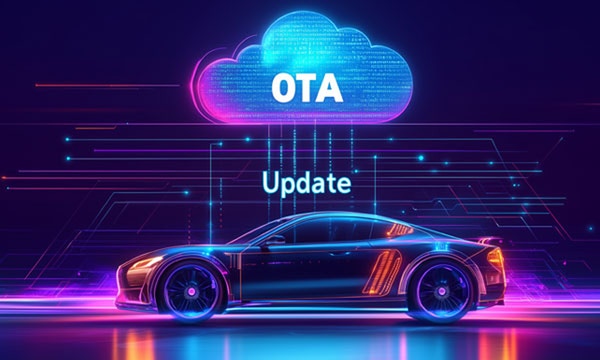
The story of the intelligent vehicle based on everything software is often told in the language of features — dashboards, apps and over-the-air updates, intended to allow its makers to stay relevant and connected with the users. But the real story doesn’t start there. It begins far earlier, deep inside the engineering DNA of the enterprise — in the invisible thread that connects design intent, validation logic, production precision and customer experience into one flow.
Imagine making a design decision that instantly triggers a virtual test. A digital twin triggers simulation before the prototype even exists. An assembly line factory floor adjusts itself based on a software change thousands of miles away. And somewhere, in a connected vehicle already on the road, the same learning is fed back into the next design cycle.
That’s not a vision of tomorrow — it’s how the most adaptive manufacturers are working today. Tesla, BYD, NIO and others aren’t simply fast because they have more talent or funding. They move faster because their data moves faster. The loops are closed. The flow is seamless.
The digital thread is not a system you install; it’s a behavior you adopt.
In these new age auto OEMs, vehicles aren’t just launched anymore — they evolve, continuously and intelligently. Products are more like living systems than manufactured assets. Progress is measured not in model years, but in self-learning and update velocity.
The industry must stop treating it as a technology project and start treating it as the substrate of transformation.
The leaders of this next chapter won’t be defined by the size of their factories, but by their ability to sense, learn and adapt — to hear the pulse of their own data and respond before competitors even notice the beat.
The reality check
The shift toward the software led intelligent vehicle is already under way — but not evenly. Some automotive manufacturers are living in the future, while others are still negotiating with the past as blueprint for what comes next
New age or software native OEMs vertically integrated software stack has become a live feedback loop — every vehicle acts as a sensor, feeding real-world data directly into design and validation pipelines. Leading Chinese OEMs have in-house control of software, battery and power electronics enables hardware-software co-design that cuts new platform launch times by nearly 50%. Other Chinese innovators have redefined validation by running concurrent virtual and physical cycles, allowing new models to reach the market in under two years.
Meanwhile, several Western OEMs are still wrestling with fragmentation. German OEMs have made bold moves toward domain-based architectures and centralized software hubs, but legacy systems still constrain end-to-end flow. US car makers have announced multi-billion-dollar investments to unify their digital platforms, yet much of their transformation remains in pilot mode — siloed by brand, geography and heritage.
This gap isn’t primarily technical — it’s cultural.
By contrast, where the digital thread has been woven successfully, the impact is visible and measurable. Real-time digital twins across production and logistics drive a significant gain in Overall Equipment Effectiveness (OEE) and reduce downtime through predictive maintenance. Linking digital design models directly with factory execution data cuts validation time and improves first-time-through quality across select lines. On the supplier side, Tier 1s have invested visibly in cloud-based ADAS validation environments, committing to scenario-based testing at a scale far beyond traditional physical road programs — illustrating the advantages of digital thread as an industrialized capability.
Even outside production, the benefits multiply. In aftersales, connected-vehicle telemetry from OEMs enables predictive service scheduling, reducing warranty costs and increasing parts profitability. By turning vehicles into data sources, service transforms from a reactive expense into a proactive customer-retention tool.
These examples are not isolated experiments. They prove that when information flows without friction — across design, build and operate — efficiency becomes exponential. The challenge for most legacy OEMs is not awareness but disconnecting from the past and aligning for the future by learning to act as one connected organism rather than a collection of proud, disconnected parts.
Data and the human: The heartbeat of automotive transformation
The next chapter of automotive transformation will not be written in press releases or product launches — it will be written in data. And yet, most OEMs are still beginning at the wrong end of transformation: they chase use cases before they have built the foundations for intelligence.
The first move must be architectural, not aspirational. Before AI, before automation, before digital twins — the enterprise needs a connected core. Data must be made consistent, contextual and continuous. Only then can intelligence circulate freely across design, validation, manufacturing and in-field operations. The digital thread creates this nervous system — an unbroken flow of information where every change, event or anomaly instantly propagates to those who can act on it.
When that substrate is in place, AI becomes the catalyst rather than the headline. It begins to close loops that once spanned months: synthetic data accelerating validation, reinforcement learning improving calibration and generative models exploring thousands of design permutations overnight. AI does not replace engineering — it accelerates it, compressing cycles and elevating the fidelity of decisions.
But the more profound shift is human. The organizations that will lead this transformation are those that stop thinking in stages and start thinking in systems — where engineering, IT and digital aren’t just functions, but facets of one intelligence. They will design processes that learn, factories that adapt and vehicles that evolve long after delivery.
This new discipline — intelligence-first transformation — demands more than technology. It requires courage to reorder priorities: to rebuild data infrastructure before feature portfolios, to measure learning velocity instead of product milestones and to see architecture not as an overhead but as the competitive edge.
The leaders in this transformation era will not be the ones who invent the most use cases, but the ones who build the fewest blind spots. Those who start with data continuity will discover that AI and automation are not destinations, but outcomes — the natural consequence of getting the architecture right.
The future of modern mobility
The intelligent vehicle or software-defined vehicle (SDV) is a revolution in plain sight. The digital thread is an invisible one. Together, they define the architecture of modern mobility — a system where code and metal evolve in sync, where learning never stops and where transformation is not measured in launches.
In the years ahead, those who embed this invisible intelligence into their core will shape the future. Those who delay may find themselves endlessly refining yesterday’s playbook.
This paper forms Volume 1 of the Automotive Transformation Series, exploring how software, data and design intelligence are reshaping the future of mobility. Future volumes will examine other key facets including, the intelligent vehicle (SDV) and AI-driven monetization amongst other topics.